

Faculty of Global Studies Department of Global Communication
Japan Studies and International Communication (JIC) Major
Improve your Japanese and English skills,
Cultivating talent who can promote "Japan"
Special Features of the Department
-
-
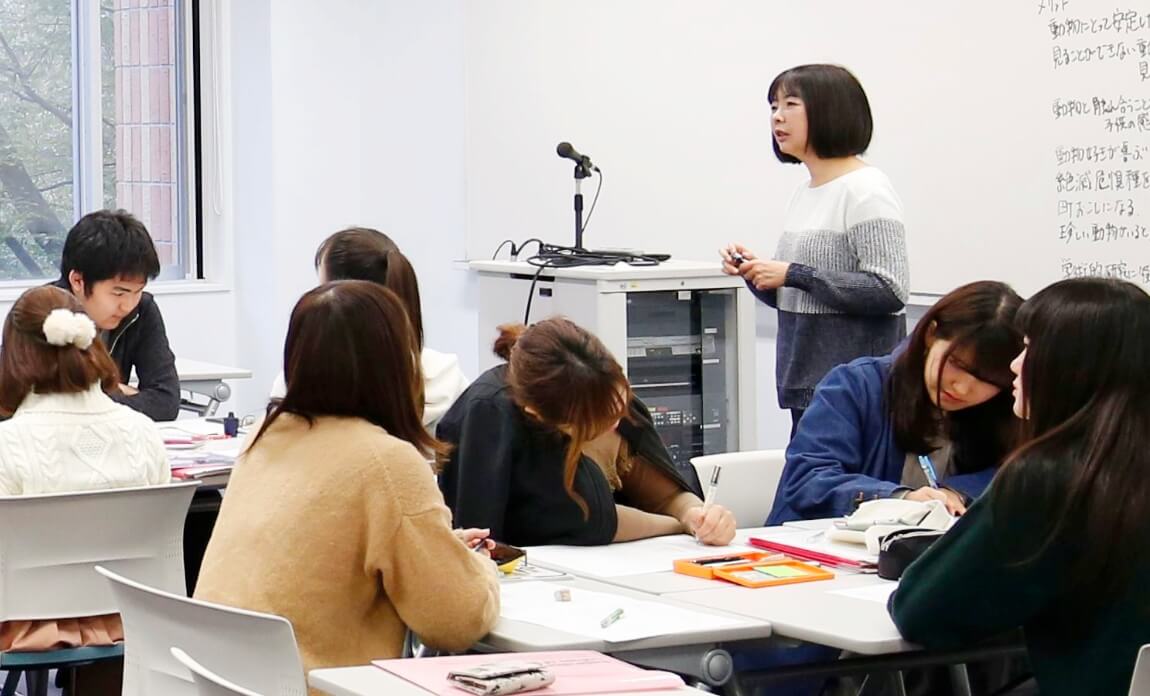
In a multicultural environment where approximately one in four students is an international student, you will hone your English and Japanese language skills and your ability to communicate about "Japan (and ourselves)." A Japanese language teacher training and practical training program is also available, where you can learn thoroughly from teachers specializing in Japanese language education.
Three points
- Acquire communication skills in both Japanese and English
- Learn about Japan and understand different cultures
- Learning alongside international students and experiencing multicultural coexistence
Flow of the four years
-
First year
Developing communication skills in Japanese and English in a multicultural environment
Students will hone their language skills in both Japanese and English and acquire the ability to express themselves. In an environment where approximately one in four students is an international student, students will experience multicultural coexistence on a daily basis. Students will learn basic knowledge and attitudes regarding intercultural understanding.
e.g.Basic Seminar, Introduction to Japanese Language Education, Basic Japanese Language Education A (Japanese Language and the World), Signs and Culture
-
Second Year
Understanding different cultures objectively by knowing Japan objectively
In order to understand a different culture, it is essential to go through the process of getting to know "ourselves = Japan" deeply. While learning a wide range of basic content such as Japanese culture and international relations, students will continue to train in Japanese and English language usage.
e.g.Academic Skills, Multicultural Coexistence, Japan Studies, Introduction to International Japanese Studies
-
3rd and 4th year
Choose a specialty from a wide range of topics and compile it into your graduation research
Based on what you learned in your first and second years, you can choose a field that interests you and deepen your expertise. There are a wide variety of fields to study, including multicultural coexistence, Japanese cultural studies, Japanese society studies, and Japanese language education.
By joining seminars and deepening your expertise, you will compile the topic you want to pursue into a "graduation research" that will be the culmination of your four years of learning. You can also take graduate school classes.e.g.Media and Society Studies B (Journalism Studies), Japanese Language Education D (Language Learning and Acquisition), Media and Culture Studies B (Semiotic Culture Studies), Media and Society Studies C (Contemporary Society and Media), Japanese Language Education H (Business Communication Studies), Japanese Language Education E (Japanese Language Theory for Coexistence), Independent Seminar
Class Introduction
-
Introduction to International Japanese Studies

Instructor: Associate Professor Morgan, Jason M.
Intercultural understanding begins with questioning and questioning our own common sense. Through discussions on a variety of topics, students will come into contact with "Japan as seen from the outside," and think about "Japan" together with Japanese people.
-
Japanese Language Education E (Japanese Language Theory for Coexistence)
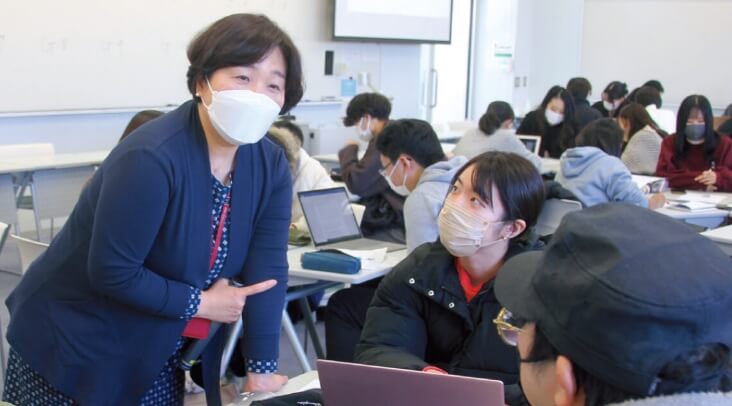
Person in charge: Professor Kim Hyogyung
This class considers Japanese language education and Japanese language learning support in a multicultural society. Through fieldwork, students learn about the types of Japanese language learning support being provided by Japanese language schools, local governments, elementary schools to universities, companies, volunteer classes, etc. Based on this class, students independently carry out volunteer activities in collaboration with off-campus Japanese language learning support groups.
-
Academic Skills A/B/C
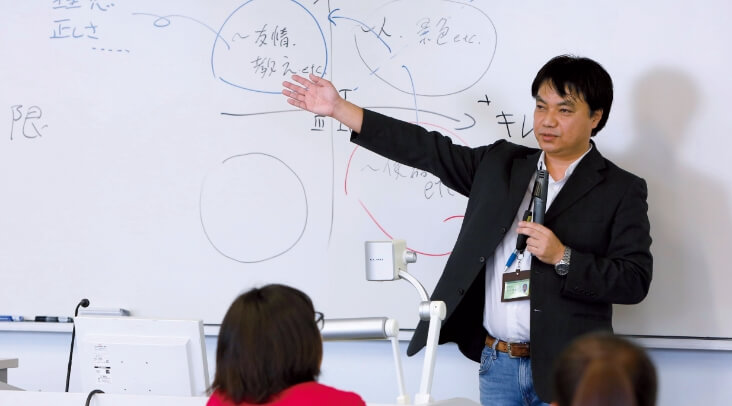
In charge: Professor Yasuhiko Nobayashi / Associate Professor Choshin Nakazono / Senior Lecturer Sakura Sasaki
In today's increasingly complex society, it is of utmost importance to be knowledgeable about how to handle information. This class will focus on three areas of training (logic, reading comprehension, and essay writing) to help students acquire advanced and specialized language information operation skills.
Student Interview
Why did you choose this major?
My interest in Japanese language education began when I was in my second year of high school. I learned that there are many children who need Japanese language support, but there is a shortage of people to provide that support. This made me think, "I want to become someone who can provide support to children with foreign connections in the future."
While considering universities to apply to, I learned that this university has a highly international environment, and I felt that I could learn about Japanese language education while being exposed to various cultures and values, which is why I chose to apply.
What are you particularly focusing on learning?
My studies focus primarily on Japanese language education, with an emphasis on acquiring fundamental knowledge. In Japanese language education classes, I consciously try to understand things from the perspective of a Japanese language learner, and while I am aware of the difficulties of treating Japanese as a foreign language, I am also enjoying the process of making new discoveries.
I am also a member of "Kodomo Nihongo Shien Smile," a student-led organization, and I actively participate in exchanges with children who have connections to other countries. I feel that this activity is the first step in providing support to these children.

Qualifications that can be acquired
TOEIC® / TOEFL® / EIKEN / Test of Practical English Proficiency (TOPIK) / Hangul Proficiency Test / Japanese Language Teaching Proficiency Test / Exemption from Basic Exam for Registered Japanese Language Teachers / Japanese Language Proficiency Test (JLPT) N1 / BJT Business Japanese Proficiency Test / IT Passport / Information Technology Engineer Examination / CG-ARTS Association Web Designer Certification Basic Expert / CG-ARTS Association Multimedia Certification Basic Expert / MOS (Microsoft Office Specialist) / Japan Chamber of Commerce and Industry Bookkeeping Certification Level 3
Target career path
Japanese language education personnel, regional coordinators, travel and tourism, hotels, media, etc.
Japanese Studies and International Communication (JIC) MajorInterview
Reitaku Journal, an online content that allows you to learn more about Reitaku University, introduces current students and active alumni studying in each department.