

企業倫理研究センター
【開催報告】企業倫理研究センター研究交流会
企業倫理研究センターでは、2026年5月9日に、日越大学(Vietnam Japan University)の大学院生・学部生による研究報告を中心とした研究交流会を開催しました。
本研究会は、学生が自身の研究の可能性を探り、新たな視点を得る機会とするとともに、ベトナムにおける企業倫理・サステナビリティ経営研究の関心や現状について、研究交流を通じて学ぶことを目的として実施されたものです。
当日は、CSR・ガバナンス・組織文化をテーマとする2本の研究報告が行われ、参加者との活発な議論・意見交換が行われました。
研究報告①
The Social Capital Mechanism in SMEs: Bridging Corporate Social Responsibility and Business Outcomes
Presenter: Tran Minh Trang
Discussant: Riu Yokota (R-BEC Research Fellow)
概要
本研究は、ベトナムの中小企業(SMEs)におけるCSR活動が、どのようにビジネス成果へと結びつくのかを、「社会関係資本(social capital)」の観点から分析したものである。
質的マルチケーススタディを通じて、CSRが関係性重視の経済における誠実性の「シグナリング・メカニズム」として機能し、取引コストの低減やレジリエンス向上につながっていることを明らかにした。さらに、CSR活動によって得られた成果が再び社会活動への投資を促す「Virtuous Feedback Loop(好循環)」が形成され、CSRが長期的持続可能性を支える「組織DNA」の一部として制度化されていくことを示した。
Background: In emerging economies like Vietnam, corporate social responsibility (CSR) remains a "black box" for small and medium-sized enterprises (SMEs), despite being well-documented in large corporations. Existing research often neglects the informal, relational nature of SME practices and does not clarify how everyday social activities translate into tangible organizational value.
Aim: This study examines the social capital mechanism that connects CSR practices to business outcomes, focusing on how the cognitive, relational, and structural dimensions of social capital serve as a bridge to organizational performance.
Methods: Employing a qualitative multi-case study design based on Eisenhardt's (1989) theory-building approach, the research analyzes four "polar cases" in Vietnam. Data were collected via semi-structured interviews and analyzed through a rigorous three-stage coding process: open coding, keyword extraction, and categorization.
Results: The findings show that CSR acts as a crucial "Signaling Mechanism" of integrity within a relational economy. By engaging in social activities, SMEs accumulate multi-dimensional social capital, which reduces transaction costs, secures preferential supplier terms, and provides a "strategic buffer" for resilience. Most importantly, the study identifies a "Virtuous Feedback Loop", where improved business outcomes reinforce the firm's motivation and resources to reinvest in social initiatives. This feedback transforms CSR from spontaneous actions into an institutionalized element of the "Organizational DNA", ensuring long-term sustainability.
Conclusion & Implications: The research demonstrates that CSR is a vital "Relational Infrastructure" for SMEs, not just a peripheral cost. It offers a context-sensitive framework for managers to leverage social capital as a competitive advantage and suggests that successful CSR outcomes generate the resources necessary to sustain a firm's social mission.
Keywords: Corporate Social Responsibility (CSR), Social Capital, SMEs, Vietnam, Virtuous Feedback Loop, Theory Building.
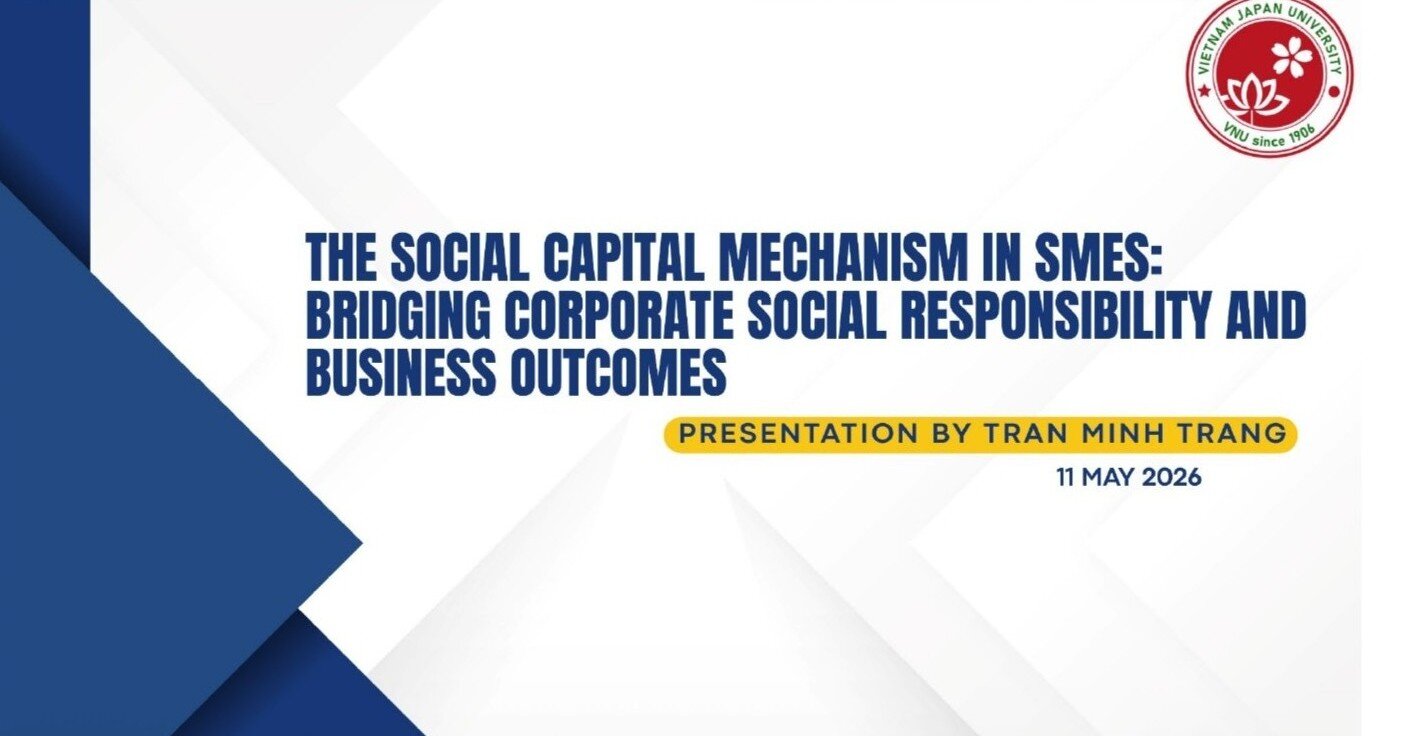
 報告者①Tran Minh Trangさん
研究報告②
The Impact of Board Gender Diversity on CSR Quality: Evidence from Japanese Companies
Presenter: Mai Ngan Giang
Discussant: Tatsuya Fujiwara (R-BEC Research Fellow)
概要
本研究は、日本企業における取締役会のジェンダー多様性が、実質的なCSRの質にどのような影響を与えるのかを検討したものである。
女性取締役比率と従業員によるCSR認識データを接続した分析の結果、実質的なジェンダー多様性はCSRの質向上と関連していた一方で、取締役会の多様性と組織内部の制度運用実態との乖離(decoupling)が存在する場合、その効果は抑制されることが示された。これらの結果は、日本企業において女性役員登用だけでなく、組織全体にわたる実質的な文化変革が必要であることを示唆している。
ABSTRACT:
This study examines whether board gender diversity in Japanese listed companies produces substantive organizational change or primarily functions as a response to institutional pressure without actually improving employees' daily experience. While prior research has largely relied on board-level disclosure data, this study adopts a bottom-up measurement approach by linking objective board composition data with large-scale employee survey perceptions at the firm level. Two hypotheses are developed and tested. The first examines whether a higher female board ratio is positively associated with employee-perceived CSR quality, and whether a board-organization decoupling index, which is the gap between board-level gender diversity and employee-perceived policy utilization, suppresses that quality. The second hypothesis mirrors this structure but shifts focus to the symbolic channel, testing whether the same variables predict employee perception that the firm's ethics system is "merely a facade." Firm-level OLS regression with heteroskedasticity-robust standard errors, analytical weights, and industry fixed effects across the samples is employed, alongside robustness checks for sample restriction and log-transformation of the board ratio variable. Findings reveal that genuine board gender diversity is positively associated with substantive CSR quality, while the decoupling between visible boardroom diversity and organizational policy reality suppresses it. However, board diversity alone does not reduce employee skepticism about the ethics system's authenticity. These results suggest that Japan's current policy focus on increasing the number of female directors is necessary but insufficient - substantive cultural transformation across the entire organization is required for board diversity to translate into meaningful employee experience.
Keywords: board gender diversity, CSR quality, symbolic compliance, substantive compliance, gender-washing, decoupling, female board ratio
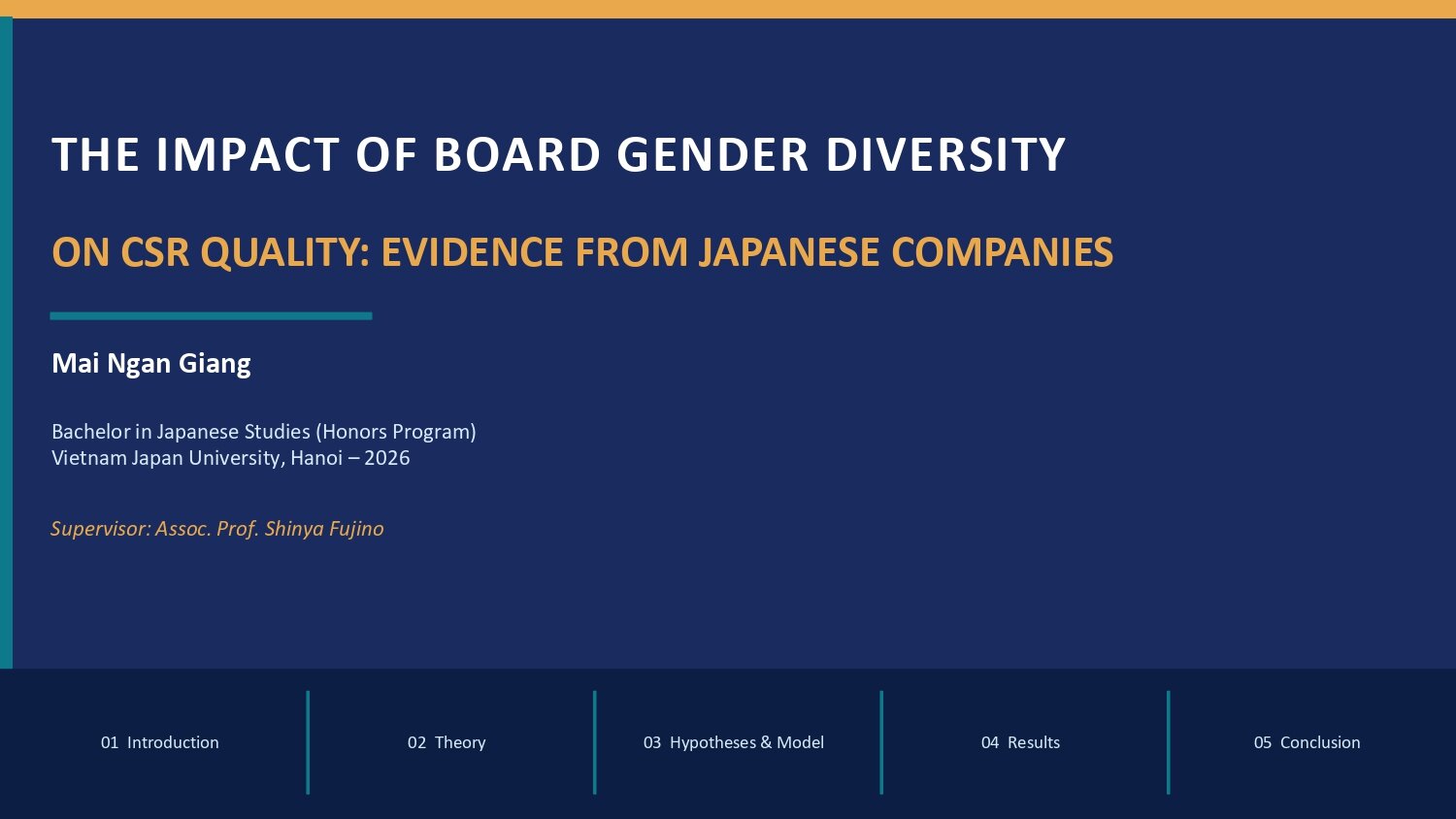
 報告者②Mai Ngan Giangさん





麗澤大学がもっとよく分かるオンラインコンテンツ